
Indian Modern Educational Institutes
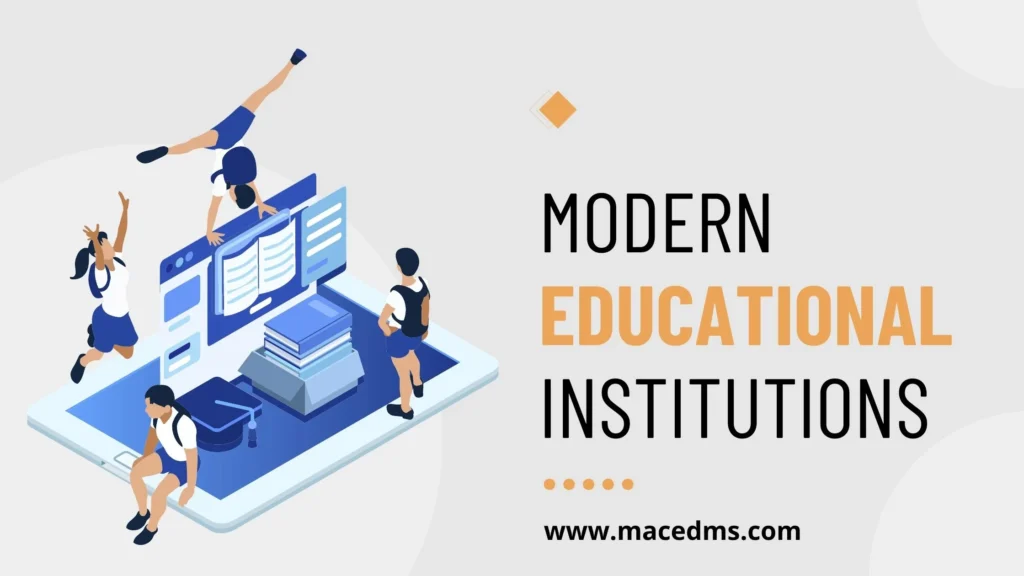
Indian Modern Educational Institutes Being the 11th largest educational system in the world, the Indian Schooling system has made efforts to improve literacy rates and expand the working module. The Indian education system has evolved tremendously over the past years. The shift from traditional rote based learning system to a modern and innovative Outlook has been remarkable. The pandemic has made it easy to bring the desired revolution in the field of education. With technological advancements it has become easier to provide a safe virtual learning environment to the students. Modern Education focuses on strengthening the intellect of students by introducing various methods and technologies. With the objective of developing analytical skills among the students the educational technology helps in facing different situations confidently. Modern education system is mainly subject to three characteristics. It expounds on the globalisation of educational targets, democrating the education process and creating a space for education of infinite time. The foundation of the modern public education system was established by Horace Mann and it reflected the industrial revolution of the concerned period. While the father of modern education is John Amos Comenius. Modern Education History The Modern School system was brought by Lord Thomas Babington Macaulay in India. In 1830 subject science and mathematics got importance and were deemed as modern subjects. India has always been an educational hub for the world. Even in ancient times India had a Gurukul system of education. But with the model School system brought into India the link between nature and the classroom got disturbed. Education was just confined to imparted in the class even the close relationship between the teacher and student got affected. Passing time boards were established in some of States. The constitution of the board was amended in 1952 and was renamed as Central board of Secondary Education (CBSE). There are numerous schools affiliated to the board present in India. The Indian government cherished a law stating universal and compulsory education for all the children in the age group of 6 to 14. Government considers that primary education is the fundamental right of every citizen of India. With such measures the Government of India is able to cover the scarcity of skilled and trained manpower. The Indian modern education system is based upon the National policy of education 2020. The modern education system focuses on restructuring the school curriculum, striving for holistic development of students, providing efficient resources and equitable education, and preserving the culture and heritage of the country. School system is divided into four levels: 1) Age 6 to 10: Lower primary2) Age 11 & 12: Upper primary3) Age 13 to 16: High school4) Age 17 & 18: Higher secondary The curriculum of the school depends upon the board and specialisation. There are mainly three streams in the school education system in India. CBSE, ICSE and stateboard. Students learn English, Hindi, their mother tongue and various other languages as subjects of the school. There are various government schools and private sector schools that may use different teaching schedules for imparting knowledge. The policy of Government of India for education has implemented the introduction of free software in school for sharing educational resources. Modern education requires various techniques and implementations for efficient flow of networks. There are very School management softwares in completing the work with utmost efficiency. Softwares helps in reducing the workload upon the Administration department and automating the monotonous work of the school. The Indian modern education system mainly talks about constructivism, IT enabled solutions and optimum utilisation of resources. With the largest States successfully migrating the softwares it has been established in the entire country could pertain to the largest use of software in general. During the times of Covid-19 pandemic it was rightly seen that the market shifted online. India successfully acknowledged the challenge and with technical assistance provided education to the citizens. The log down period was a true projection of the new approach of learning of the 21st Century. The modern age education system of India is a drastic change striving towards online education. Modern Education v/s Traditional Education There is a very big difference between the modern education and traditional education system. The conventional education system popularly known as traditional education works with the motive of providing knowledge from generation to generation for survival. Education is all about important and acquiring knowledge through various mediums. In the ancient times sharing information was all about gatherings, learning language, acquiring values, and acknowledging religious beliefs. But with the changing time the education system also enhanced. Education changed its path from human struggle towards enlightenment and fight for survival. Traditional education: The traditional education system was all about children acquiring knowledge from their ancestors. The knowledge provided was all about the skills required for survival. Such as knowledge about tools, rituals, customs, hunting and how to gather food. is the perfect example for traditional education. Students were taught about religions, stories about various Gods, and kings from whom they could learn valor and good morals. Knowledge about sustaining the environment, protecting themselves and providing basic outlook of ruling an Empire were taught. Such a system was not relevant for the local population. The royal families would let their children possess skills and knowledge from Gurukul. Traditional education system was far away from the use of science and technology. There was very little or minimal written work during that time. Students were subject to only listening to the teacher who would recite the lesson. At times they were oral tests taken though it was not solely formal. The education of that time is widely different from the knowledge please receive in today’s time. The traditional education system contains knowledge about customs, traditions and religions with the motive of passing values to the next generation. Education was only subjected to fulfilling the needs. There was a lot of discrimination happening all around the country as education was not meant for all. Only the royal families and high class society people